How to Reduce Returns, Build Engagement, and Increase Conversions? Fashion M-Commerce App Trends for 2026


Bracketing and growing return rates are among the critical challenges in the fashion e-commerce industry. Add to this low app retention, abandoned carts, and declining engagement.
How to mitigate these issues? In 2026, the answer lies in technologies enabling precise product matching.
Discover which solutions—from Virtual Try-On to Agentic AI—can influence user behavior, reduce return costs, and drive in-app conversions.
Key takeaways
- High product return rates caused by bracketing (purchasing multiple sizes to try at home), alongside low app retention and high cart abandonment, generate severe logistical and processing costs in fashion e-commerce.
- Mitigating these overheads requires transitioning from generic customer segmentation to precise product-matching technologies and hyper-personalization frameworks driven by multi-source data.
- Implementing advanced technical solutions like Virtual Try-On (VTO), visual search, and Agentic AI allows systems to visualize garment fit accurately, process screenshot-based queries, and automate proactive customer support journeys.
- Integrating conversational AI agents and predictive matching tools optimizes the purchase decision funnel, directly lowering the average 17% e-commerce return rate and reducing return-associated losses that consume up to 65% of a product’s value.
Bracketing and e-commerce returns generate high costs
According to a report by the National Retail Federation (NRF) and Happy Returns, the average e-commerce return rate reached nearly 17% in 2024. The cost associated with these returns is a particularly acute pain point—ranging from 20% to as much as 65% of the product’s original value.
In the fashion e-commerce sector, this issue is exacerbated by bracketing. This phenomenon occurs when customers purchase multiple versions of the same item in different sizes to try them on at home, only to return the ill-fitting ones. How can retailers tackle this challenge?
Virtual Try-On – making choices easier
Currently, when selecting sizes and colors, customers rely primarily on size charts and product photos. Sometimes, the app also features reviews from other customers regarding a specific garment. However, this is often not enough to make the right decision.
The solution may be a virtual fitting room, or VTO (Virtual Try-On), which allows users to see how a sweater or dress looks on the customer. This is made possible by, among others, Google’s new technology utilizing generative AI. How does it work? The user uploads a photo of themselves in form-fitting clothes—preferably showing their full silhouette. The AI then analyzes it and overlays the previously viewed item onto the photo so that it looks as if the customer is actually wearing it.
The visualization even accounts for fabric folds, enabling the user to make a purchase decision with greater confidence. In this way, you can reduce the number of returns caused by choosing the wrong color or cut.
For now, this technology is a novelty, but it may soon become a new standard in the e-commerce world. It is worth considering now whether it could be implemented in your online store.
AR as an alternative
The virtual fitting room effect can also be achieved through other means. One option is AR technology, which overlays a visualization of shoes onto the user’s feet or glasses onto their face. Over 60% of US consumers use AR features while shopping, according to the AR in e-commerce market report. The vast majority of them (nearly 90%) state that this technology helps them make a decision.
However, the truth is that AR visualizations often produce an unnatural effect, especially with clothing—fabrics can drape differently on the body, unlike shoes or glasses. Therefore, when developing a strategy for 2026, it is worth at least analyzing the use of other technologies.
Hyper-personalization in e-commerce
Hyper-personalization is one of the key technology trends for 2026 impacting mobile apps. Standard retail practice involves grouping customers into segments sharing a common trait, such as age, gender, or location. Each of these groups is targeted with slightly different messaging and product offers.
Hyper-personalization, however, takes it a step further by treating each user individually. Based on vast amounts of data from various sources (Customer Data Platforms, CDP), it is possible to, for example:
- display a different user interface layout to the customer
- show banners that are more likely to interest them
- present product recommendations and promotional offers better matched to their preferences
- send personalized email content.
The result? The brand engages the user more effectively and builds a closer relationship with them.
Solutions enabling better personalization include, among others, visual search (aiding in product discovery) and Agentic AI.
Visual search – sposób na lepsze wyszukiwanie produktów
While a wide product range is an advantage for an online store in many respects, it also has a downside. If a customer has very specific needs, finding the right clothing takes longer. It often requires applying multiple filters. Standard search isn’t always sufficient either. Sometimes, users are unsure how to name a specific cut, fabric, or type of embellishment.
This is where visual search comes in handy. Users can search for clothing and accessories based on photos of items they encounter in their surroundings or while browsing on their smartphones.
Example
Anna sees an amaranth dress on TikTok featuring an irregular neckline, midi length, and adorned with pink rhinestones. The garment is made of a shiny material combined with a sheer fabric whose name Anna doesn’t know. The dress is fitted in some areas and loose in others. It is hard to tell whether it is evening wear or a casual outfit.
As you can see, the description is quite long and full of unknowns, making it unclear how to find the dress in stores.
However, visual search allows users to find products similar to the one shown in a screenshot. There is no need to worry about selecting filters or knowing how to name the fabric or cut. The algorithm will find suitable dresses on its own and suggest products highly likely to match the customer’s taste.
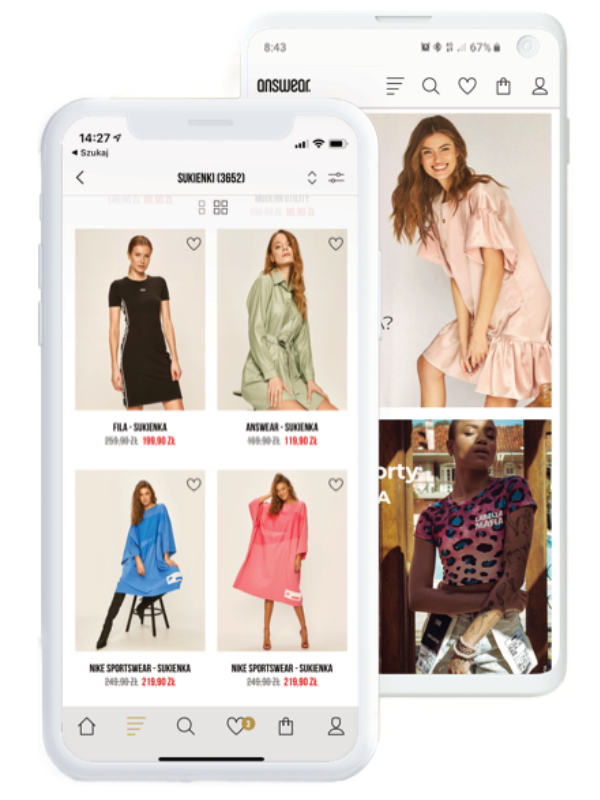
Answear app enables visual search.
Agentic commerce: How an AI agent can support customers?
Visual search has many benefits, but the customer needs to have a photo of the product. But what if they only have a vague vision of what they want, and a limited budget? In that case, the customer journey lengthens, and the risk increases that a discouraged customer will abandon the purchase.
Agentic AI (agentic commerce) is an approach intended to replace standard chatbots by offering proactive action. What does this mean? The user can describe or speak out what they are looking for, and the AI agent will handle the rest.
Example
Let’s assume Anna is looking for a white, long-sleeved shirt made of high-quality fabric, in size M, for under $60. She tells the AI agent, and the tool searches for various products available in the store that meet these criteria. It can then compare the pros and cons of the selected products and even directly assist with payment.
That’s not all. Suppose Anna receives the shirt and notices a button is missing. She can instruct the agent to guide her on how to file a complaint. Such an agent acts as a personal assistant, facilitating interactions with the store at every stage of the shopping journey.
Agentic commerce in the US could reach a value of up to $500 billion by 2030, according to forecasts by Bain & Company. It is therefore worth exploring this technology and checking how to prepare your online store for its implementation.
Investment in technology: Prepare your store for changes
Visual search, Virtual Try-On, and Agentic AI are not just buzzwords; they are technologies with a real impact on how modern e-commerce apps can operate. In fact, there are many more solutions capable of significantly boosting your online sales. How do you determine which changes are worth implementing in your store?
Start with an app audit—it should be analyzed from both UX and technological perspectives. Next, define the business goals you aim to achieve next year and to us about the options worth considering for your specific case. Together, we will determine which solutions will work best for your app.
In the fashion m-commerce industry, the success of a new app often hinges on how quickly it reaches customers. Instead of building architecture from scratch and wasting months configuring core mechanisms, it is better to rely on ready-made standards. See how we shorten development time with the Rappid Workflow system, allowing fashion brands to enter the mobile market faster.
FAQ
What is a Virtual Try-On?
It is a technology that allows users to see how a specific piece of clothing looks on a real person. The user uploads their photo, and AI overlays the selected garment onto it, taking into account even the folds of the fabric. This is designed to help customers make an informed purchasing decision and reduce return rates caused by choosing the wrong color or fit.
What is hyper-personalization in e-commerce?
It is an approach that treats each user individually, unlike standard customer segmentation based on shared traits (e.g., age, gender, location). Drawing on data from multiple sources, it allows you to adapt elements like interface layouts, banners, product recommendations, and communication content to a specific person.
What is visual search and when is it useful?
Visual search is finding products using an image rather than a text description. It is especially useful when a customer cannot accurately describe the cut, material, or detailing of a garment they like. In that case, they can simply upload a photo, and the algorithm will suggest similar products.
Where to start implementing new technologies in your fashion e-commerce app?
It is worth starting with an app audit covering both UX and technology, and then defining the specific business goals you want to achieve in the coming year. Based on this, you can select the solutions (e.g., Virtual Try-On or visual search) that best respond to the needs of your specific store.